The agent model
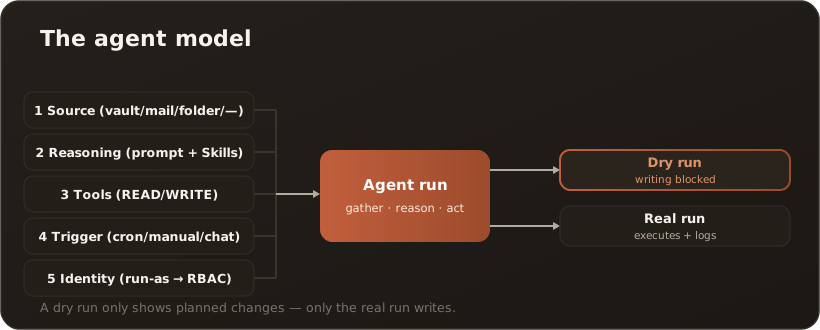
AllAn agent carries out a recurring task on its own. So that this happens predictably and safely, every agent is assembled from five building blocks. Anyone who knows these understands any agent — and can test it safely.
The five building blocks
Section titled “The five building blocks”- Source — where the agent takes its input from: a vault (knowledge area), an email mailbox, a working folder (desktop only) or none (just a prompt). A “scope” narrows down which part of the source applies.
- Reasoning — the instruction (system prompt) plus optional Skills that shape the approach. An optional result schema turns the final answer into a JSON result.
- Tools — the tools the agent is allowed to use. Each is marked as read (READ) or write (WRITE) — decisive for the risk assessment. A storage target (vault folder or working folder) sets where writing tools may write.
- Trigger — when it runs: on a schedule (cron), manually, as a dry run or triggered by a chat message.
- Identity — under which user the agent runs. This determines its rights (RBAC): an agent sees and does only what that user would be allowed to.
How a run proceeds
Section titled “How a run proceeds”The agent run gathers input from the source, reasons with the model, instruction and Skills, and uses the permitted tools along the way. In a dry run, all write tools are blocked — the agent only shows what it would change (“Planned changes”). Process items one by one is suppressed as well: it only reads, but it triggers paid model calls. → Tools: Process many files or mails one by one Only the real run executes write actions. Every run is logged.
Safety principle: Reading is harmless, writing needs trust. Combine WRITE tools with automatic triggers only after a successful dry run.
Related
Section titled “Related”- Create an agent and test it in a dry run
- Connect an MCP server — provides additional tools
- Chain agents — storage target, only new files, JSON result